Interactive Drain & Pressure Triage
Why Tank Pressure & Feed Pressure Must Balance
In a standard non-pumped RO system, the 4-way Automatic Shut-Off (ASO) valve relies on back-pressure from the pressurized storage tank reaching roughly 60%–67% of your incoming line pressure to shut off feed water.
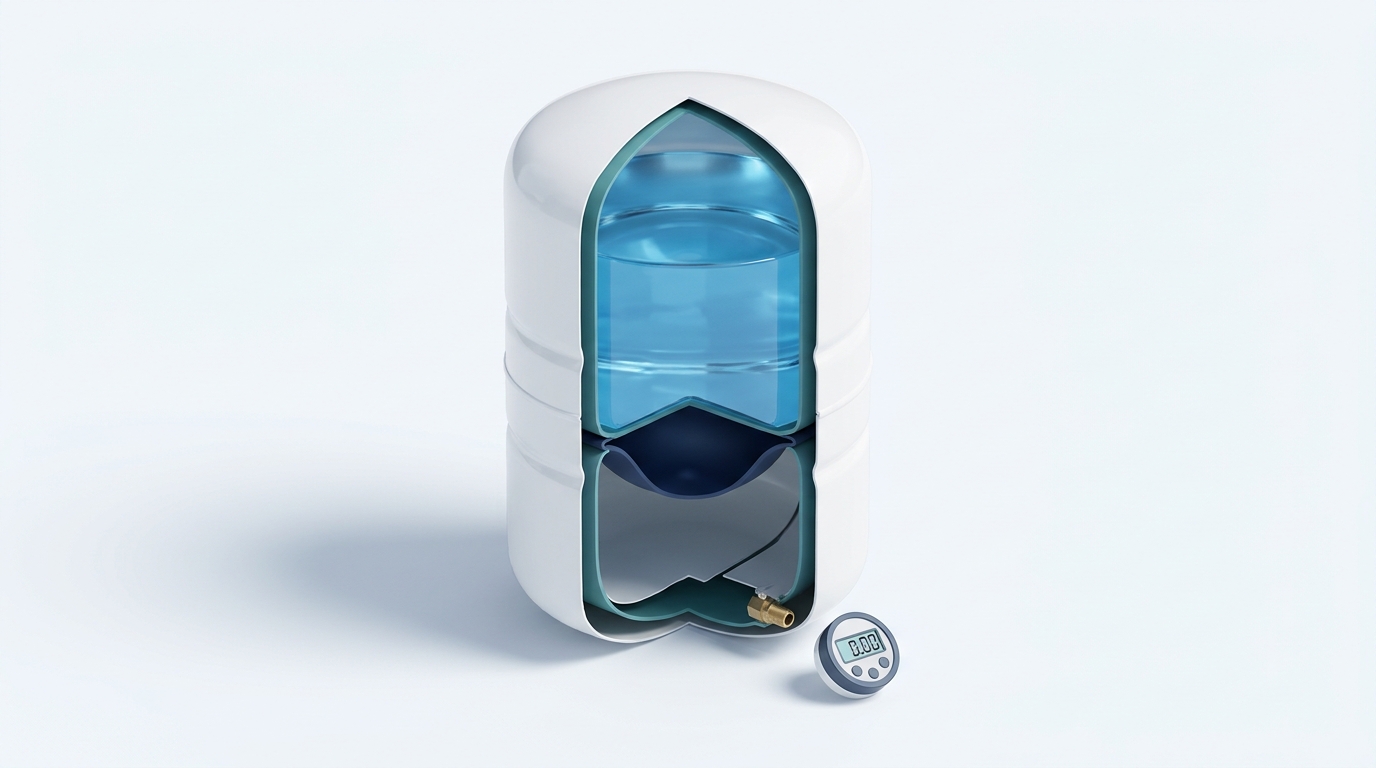
If your household supply drops below 40 psi, or if the storage tank bladder loses its 7–10 psi empty air charge, the tank cannot push back hard enough—so the ASO valve stays open and water runs to the drain endlessly.
Step-by-Step: How to Safely Check & Recharge Tank Air Pressure
- Shut off the cold supply valve feeding the RO system (leave the tank ball valve open so the tank can drain).
- Open the RO drinking faucet and let it drain until the stream stops completely. If the tank still feels heavy like a bowling ball even though nothing comes out, the bladder has zero air pressure behind it.
- Connect a digital tire pressure gauge to the Schrader air valve (usually under a blue cap near the bottom of the tank).
- Pump air slowly with a bicycle pump while the RO faucet remains open—more trapped water will sputter out of the faucet as the bladder expands. Stop when the completely empty tank holds 7–10 psi.
- Check for bladder failure: If water squirts out of the Schrader air valve when you press the pin, the internal rubber diaphragm has ruptured and the storage tank must be replaced.
Key Valve & Component Reference
| Component | Where It Sits | Failure Symptom | Typical Action |
|---|---|---|---|
| 4-Way ASO Valve | Mounted above membrane housing (4 tubes) | System never stops running to drain even when tank is full and pressurized | Replace ASO valve (~$10–$18 part); verify IN/OUT ports match tubing |
| Permeate Check Valve | Elbow fitting on RO membrane pure-water outlet | Tank pressure leaks back into membrane; drain runs non-stop and tank empties | Unscrew elbow and replace check valve (~$5–$10 part) |
| Drain Flow Restrictor | Inside 1/4" drain line (matched to membrane GPD) | Missing/wrong restrictor causes zero tank pressure and constant roaring drain | Confirm GPD rating (e.g., 50/75 GPD) matches your membrane |
| Permeate / Booster Pump | Optional add-on for feed pressure <40 psi | Tank fills painfully slow; waste ratio exceeds 5:1 | Add electric booster pump or non-electric permeate pump |
Understanding Normal Waste-to-Pure Ratios
Traditional tank-based RO systems without a permeate pump typically run at a 3:1 to 4:1 waste-to-pure ratio (3–4 gallons to drain for every 1 gallon of drinking water). While that sounds wasteful, a family drinking 3 gallons/day uses roughly 360 gallons/month of drain water—about the same as 3–4 extra toilet flushes per day. Only a non-stop drain line running 24/7 wastes thousands of gallons per month and requires immediate ASO/check-valve service.
Why Winter Water & Low Pressure Slow Production
Standard RO membrane GPD ratings (such as 50 GPD or 75 GPD) are factory-rated at 77°F (25°C) and 50–65 psi. In colder regions where incoming groundwater drops to 45–50°F, water viscosity increases and membrane production can drop by 30%–45%. Combined with household supply pressure below 40 psi, a tank can take twice as long to refill—making it look like the system is running continuously to drain even when valves are intact.